
Posing for Pictures Feels Awkward — Here’s How to Fix That
Disclosure: This post may contain affiliate links. I may earn a small commission if you click a link or make a purchase, at no additional cost to you. See my disclosure for more info.
If posing for pictures has always made you feel like you’re auditioning for something you didn’t sign up for, that’s a more common experience than most people admit. The discomfort isn’t shyness — it’s that you’re being asked to look natural while being very aware you’re being watched, and those two things don’t naturally go together. This guide isn’t a pose list. It’s about the mental and physical shifts that separate people who consistently look good in photos from people who don’t — and how to get there. For the specific poses organized by situation, see our poses for photos guide.
Why Posing for Pictures Feels Uncomfortable
Most people feel awkward posing because they’re running two conflicting programs simultaneously: trying to look natural and being acutely aware they’re being observed. That tension shows. The goal isn’t to eliminate it — the goal is to route around it.
The most effective technique professional models use: stop trying to look good and start thinking about doing something. Reach for an object. Start walking somewhere. Look at something off-frame. When the brain is focused on a task, it stops managing the performance, and the result is more natural. This isn’t a metaphor — it works on the first try.
The second thing: most people don’t actually know what their face looks like when they’re not posing. Your resting expression is not what you look like when you’re not thinking about it — it’s what you look like when you’re thinking about not thinking about it. The fix is to collect reference photos of yourself actually being candid and understand what your face does in different situations. That data is more useful than any amount of mirror practice.
What Your Body Is Doing Before the Camera Clicks
There are three physical defaults that almost always produce unflattering photos, and most people do all three without realizing it.
Equal weight on both feet
Standing with weight distributed evenly creates a square, flat posture. Put your weight on one foot and let the hip drop slightly on the other side. The posture becomes dynamic immediately. You can see this in any photo of someone who looks comfortable being photographed versus someone who doesn’t — the difference is almost always in how the weight is distributed.
Both shoulders at the same level
When you stand squared to the camera with both shoulders level, the photo is symmetrical — and symmetrical poses read as stiff. Tilt your head toward the lower shoulder slightly, or angle your body 45 degrees away from the lens. Either creates asymmetry that reads as relaxed rather than formal.
Facing straight-on to the camera
The three-quarter turn — facing 45 degrees away from the camera — is more flattering than face-on for almost every body type. It creates depth and dimension that squared-up standing doesn’t. Pair it with weight on the back foot and one shoulder slightly lower, and the posture takes care of itself.
The chin trick
Push your face forward and slightly down — not dramatically, just a small forward extension from the neck. This elongates the jaw line and eliminates the compressed look that comes from pulling the chin back. It feels unnatural at first. It looks correct in every photo. Every professional photographer knows this trick and tells their subjects to do it. Now you know it too.
Why Movement Always Beats Stillness
Still photos of still people look static. Still photos of people mid-motion look alive. This is consistent and almost universal — compare any candid photo of yourself to any “posed” photo and you’ll see it immediately.
The practical version: instead of standing in position and holding it for the shutter, transition into the pose while the shutter fires. Sit down while someone shoots. Turn around mid-step. Pull your jacket on. Take a sip of something. The camera captures you mid-motion, which eliminates the held quality that makes posed photos look posed.
For self-timer shots: set the timer to continuous burst mode, trigger the shutter, and do something — walk, turn, laugh, look away and back. You’re not trying to hit a specific pose at a specific millisecond. You’re generating fifteen frames of natural movement and finding the one or two that work. This approach works on every camera — for gear that handles burst mode and self-timer well, our best camera for beginners guide covers the top-rated options.
What to Do With Your Face
The reason “say cheese” ruins photos: it asks your face to hold a static expression for an undefined period of time. Static expressions look held because they are. Here’s what actually works.
Think of something that actually makes you laugh
Not staged laughing. A real memory, a real thing that happened, an inside joke. The camera captures the real version, and real laughter is practically impossible to fake convincingly. Even if the laugh is brief, the frame that catches the beginning of it looks more genuine than thirty frames of a held smile.
Slightly open your mouth
A closed-mouth, forced smile is the least flattering default expression in photos. Slightly open — not a full open-mouth grin, just a relaxed, soft expression — reads as more natural. If you’re not sure what this looks like, take ten photos in a row with slightly different mouth positions and compare. The difference between “teeth just barely showing” and “forced full smile” is significant.
Look away, then snap back
Look away from the camera — at something in the environment, down at your hands, toward whoever is shooting — and then look back just as the shutter fires. The moment of genuine eye contact with the lens, after looking elsewhere, registers as natural because it is. You’re not holding a “look at the camera” expression. You’re making actual eye contact.
Posing in Specific Situations
Outdoor Photos
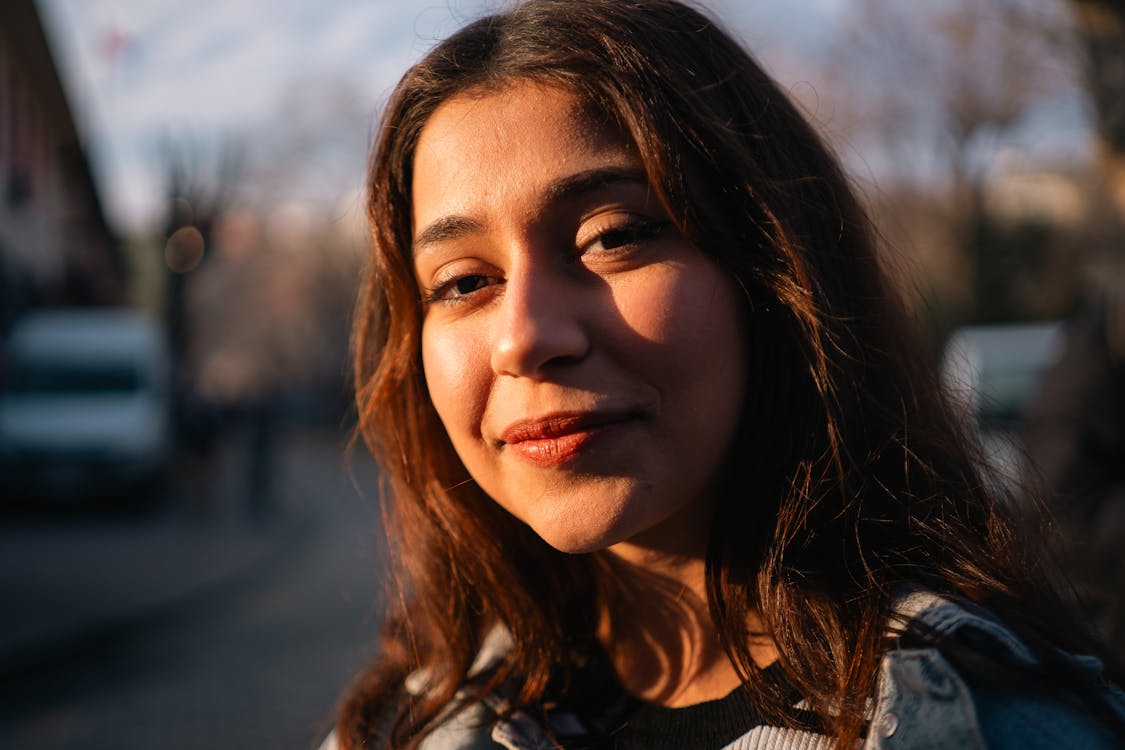
Light is your most important variable outdoors — more important than the pose. Shoot facing away from the sun or in open shade. Golden hour (60 minutes before sunset) eliminates almost all harsh shadows. Move to find the light rather than staying fixed in one spot. A mediocre pose in great light beats a great pose in bad light every time.
The outdoor poses that translate most naturally: walking, leaning against natural elements (trees, rocks, fence rails), and sitting on terrain. For specific outdoor pose references organized by setting, see our poses for photos guide.
Mirror Pics
Everyone looks slightly different in a mirror than in a camera photo. A mirror flips your image horizontally, and you’ve spent your whole life looking at that version of yourself. The camera shows other people’s version of you. Neither is more accurate — they’re just different. Getting comfortable with photos means getting familiar with the unflipped version.
For mirror posing specifically: one hand on the mirror frame or resting against the wall, one hand in a pocket or on your hip. Weight on one foot. Look at the camera, not at yourself in the mirror. Looking at yourself during a mirror pic creates a preoccupied expression that the camera always catches.
Group Photos
The person who looks best in group photos is almost always the one who’s slightly angled toward the center rather than squared to the camera, making physical contact with the person next to them, and leaning in rather than standing straight. Stand at a 45-degree angle, touch the person beside you (hands on shoulders, arm around waist), and lean slightly toward the center of the group. That combination works every time.
Couple and Engagement Photos
The mindset shift that matters most for couple poses: stop thinking about what you look like individually and start thinking about the physical connection between you and the other person. Where are your hands? Where is your weight? What are you actually looking at? The photos that look good for couples almost always involve genuine physical contact and genuine attention to each other rather than to the camera. For specific couple pose breakdowns, our engagement photos guide goes through every situation.
Building the Habit
The people who always look good in photos have done one thing: they’ve taken a lot of photos. Not in front of mirrors — in front of cameras, in real situations. The habit that works: take ten frames every time you’d normally take one. Review them immediately, without judgment about the result. Notice what worked, what didn’t, and specifically why. Within a month of this, you’ll know exactly what your face and body do in different situations and you’ll know which small adjustments to make before the shutter fires.
The tool that makes this easier on your own: a tripod with a Bluetooth remote. Set up a frame, cycle through positions, shoot in burst mode, review. For specific gear recommendations that support this kind of regular self-directed practice, our best camera for beginners guide covers the cameras that make solo shooting practical.
Posing for Pictures FAQ
Why do I look different in photos than in the mirror?
Because a mirror flips your image horizontally. You’ve spent your entire life looking at that flipped version, so it’s the one your brain registers as “what I look like.” A camera shows you the unflipped version — which is what everyone else sees. Most people look better than they expect once they stop comparing photos to the mirror and start evaluating photos on their own terms, without the reference point of the flipped image.
How do I stop squinting in photos?
Squinting happens when the sun is hitting your face directly. Face away from the sun or move to open shade. If you’re shooting indoors under bright overhead light, reposition near a window with natural side light. If you’re in a situation you can’t control, try looking away just before the shutter fires and then snapping back — the brief return of eye contact reads as natural rather than squinting.
What’s the fastest way to get better at posing?
Take more photos and review them immediately. The feedback loop is the practice. Most people avoid looking at photos of themselves because they don’t like the results — that’s exactly backwards. The photos you dislike contain all the information you need to improve. What specifically bothered you? Jaw angle? Expression? Posture? Identify it specifically, adjust, and test again. Improvement comes from data, not from general discomfort avoidance.
Is it possible to look good in photos without practice?
Yes, for some people in some situations — usually when they’re genuinely not thinking about the camera. Candid photos of people absorbed in something they care about look good because the person is focused on the thing, not on being photographed. You can replicate this intentionally by giving yourself something to focus on: a task, a conversation, a real moment to react to. The camera captures the result of that focus, and it reads as natural because the focus was real.
Why do some people always look good in photos?
They’ve been photographed a lot and they’ve looked at those photos. That’s almost the entire answer. Bone structure and photogenic luck exist, but they account for a smaller percentage of why some people consistently look good in photos than most people assume. Body awareness, comfort with the camera, and a few practiced adjustments (chin forward, weight on one foot, hands with a purpose) account for the majority. These are learnable. They just require the kind of deliberate feedback that most people don’t seek out because looking at photos of themselves feels bad.
Should I look at the camera or away from it?
Both work, and both look different. Looking at the camera creates connection and directness. Looking away creates a candid, editorial quality. The mistake is holding either one — looking at the camera for too long creates a fixed, unnatural expression. Looking away for the entire session creates a disconnected feel. Alternate between both within a session, and use movement (looking away then back) to create natural transitions between the two.