
Why Your Indoor and Night Photos Still Look Bad (It’s Not Your Camera)
Disclosure: This post may contain affiliate links. I may earn a small commission if you click a link or make a purchase, at no additional cost to you. See my disclosure for more info.
You’ve adjusted the ISO. You’ve watched the tutorials. Your indoor and night photos still come out too dark, too grainy, or washed out in a way that makes everyone look bad. It’s not your camera and it’s not your skill. It’s the light source. Here’s what’s actually wrong and how to fix it.
This post includes affiliate links. We may earn a small commission if you buy something.
Why built-in flash always looks bad
Your camera’s built-in flash sits directly in line with the lens and fires straight at your face. That gives you flat, harsh, direct light with no dimension. It wipes out texture, creates hard shadows, and makes skin look washed out. It’s not a power problem. It’s a physics problem. A tiny light source pointed straight at you will always look bad.
The fix is getting the light off-axis, closer to you, and diffused. There are two ways to do that depending on what you’re shooting with.
If you’re shooting on your phone
Don’t use your phone’s flash at all. It’s worse than no flash for portraits. Instead, use a small LED panel. A Lume Cube Panel Mini is about the size of a credit card, runs on USB, and creates soft continuous light you can position anywhere. Hold it to one side of your face, or clip it to your phone. Around $60. The difference compared to your phone’s built-in flash is not subtle.
If you’re shooting on a real camera
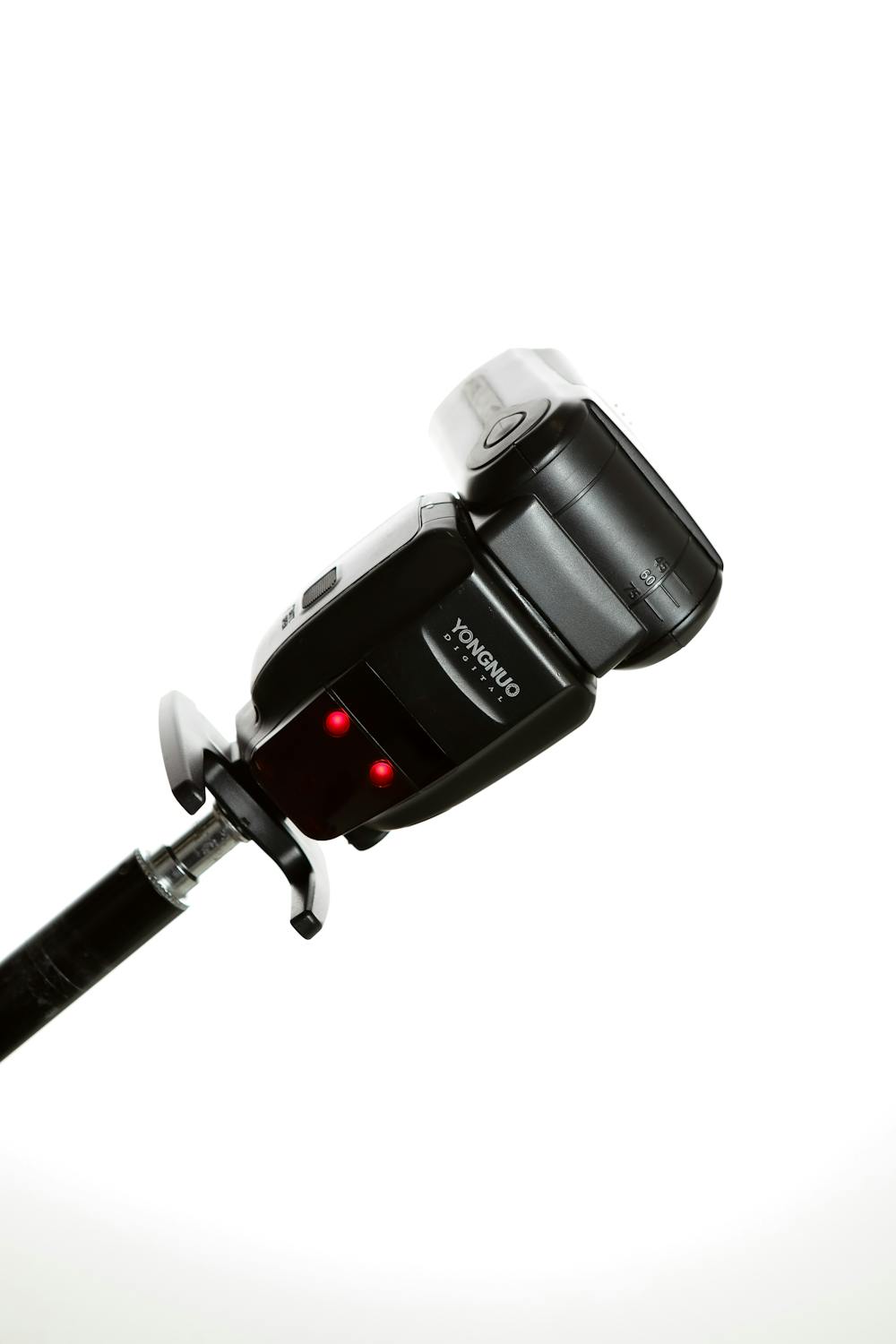
An external flash mounted on your camera’s hot shoe, aimed at the ceiling and bounced, turns the entire ceiling into a giant softbox. The light wraps around you from above and the sides. No harsh shadows, no washed-out skin, no flat face. It looks like a studio setup with a single $180 unit.
The Godox V860III is the standard choice. Uses a lithium battery instead of AAs so it recycles in about 1.5 seconds and gives you 480+ full-power shots per charge. TTL metering handles the exposure automatically. Works with Canon, Nikon, Sony, and Fujifilm bodies. Around $180.
If you shoot with a Canon G7X Mark III, which has no hot shoe, the V860III can still fire as an optical slave triggered by the G7X’s pop-up flash. Set the flash to optical slave mode, position it off to one side, and the camera triggers it automatically. You get off-camera flash from a camera that technically doesn’t support it.
The golden silhouette technique
This is worth knowing. When you’re shooting outdoors with the sun behind your subject, backlight creates a golden rim around the hair and shoulders but the face goes dark. Most people give up here. The fix is fill flash: fire the external flash from the camera position while the sun creates the rim from behind. The result is a subject with a glowing gold outline and a properly lit face. It’s the look that photographers charge hundreds for, and it’s just backlight plus fill flash.
Bounce vs direct
Always bounce when you can. Tilt the flash head up toward the ceiling or at a wall. Any room with a white or light-colored ceiling under about 12 feet works. The bounce creates soft, even, wraparound light. Direct flash pointed at your subject looks like a mug shot. For outdoor situations with nothing to bounce off, a cheap diffuser dome over the flash head softens the light enough to be usable.
The short version
Phone shooter: ditch the built-in flash, get a small LED panel like the Lume Cube. Camera shooter: get an external flash, bounce it off the ceiling, and your indoor photos will look completely different. The Godox V860III works across most camera brands and it’s the one to get. Bring Eneloop Pro rechargeable AAs as backup and a fast SD card so you’re not waiting between shots.
Which light is right for you
It comes down to what you’re shooting with and where.
If you shoot with a digital camera: Godox TT600
The Godox TT600 is the move. It fires in optical slave mode, which means it triggers automatically off your camera’s built-in popup flash. No hotshoe required. Works with the Canon G7X and most compact cameras. You get a full external flash at $65 without any extra triggers or adapters.
If you shoot with your phone: Lume Cube Panel Mini
Your phone doesn’t have a flash sync port, so a speedlite won’t work. The Lume Cube Panel Mini is a small continuous LED panel you hold next to your phone or clip to a tripod. It runs on battery, fits in a bag, and fixes the flat overhead cafe light problem instantly. $69.99 and the most-used light by phone shooters.
Budget option: Neewer TT560
If $65 is too much right now, the Neewer TT560 gets the job done at $54. It’s manual-only with no wireless, but for learning flash basics it’s a solid starting point.
The golden rim technique
This is the shot you’ve seen and couldn’t figure out. Subject with a glowing rim of light around them, warm and cinematic. Here’s exactly how it works.
You need two light sources: the sun behind your subject and a flash in front. Shoot during golden hour. Position your subject so the sun is at their back. Fire the TT600 from the front, aimed at their face. The sun lights the rim. The flash fills in the shadows on their face. You get the glow without the dark, muddy front.
The TT600 on optical slave handles this without any setup. Pop your camera’s built-in flash, the TT600 fires. Done.